
In This Article
Ever found yourself wrestling with a paper towel roll while your hands are covered in raw chicken juice? Or touched a grimy public restroom dispenser and immediately regretted it? Welcome to 2025, where your kitchen and bathroom deserve better than that awkward dance with traditional dispensers.
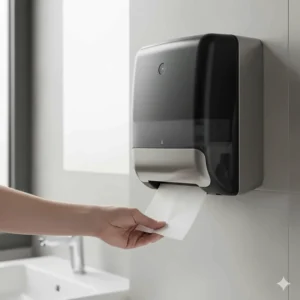
A towel dispenser touchless system isn’t just a fancy gadget—it’s a game-changer for modern hygiene. These smart devices use motion sensors to deliver paper towels without you touching a single surface, slashing cross-contamination risks by up to 80% compared to manual dispensers. Whether you’re outfitting a busy commercial kitchen or upgrading your home, hands-free dispensing has become less of a luxury and more of a necessity in our health-conscious world.
The market has exploded with options ranging from sleek countertop models perfect for residential kitchens to heavy-duty commercial units built for restaurants and hospitals. You’ll find budget-friendly picks under $30 and premium systems exceeding $200, each promising to transform how you access paper towels. But here’s the thing: not all touchless dispensers live up to the hype. Some jam constantly, others drain batteries faster than your teenager uses data, and a few are so finicky they’ll leave you longing for the good old manual pull.
Quick Comparison Table: Top Towel Dispenser Touchless Models
| Product | Type | Price Range | Power Source | Key Feature | Best For |
|---|---|---|---|---|---|
| Innovia Countertop | Countertop | $100-120 | Battery/AC | Smart sensor tech | Home kitchens |
| Innovia Under Cabinet | Wall Mount | $95-110 | AC only | Space-saving | Small kitchens |
| enMotion 10″ by GP PRO | Commercial | $175-225 | Battery | 150-roll battery life | High-traffic areas |
| San Jamar Tear-N-Dry | Commercial | $85-120 | Battery | Jam-free design | Restaurants |
| Pacific Blue Ultra 8″ | Commercial | $120-160 | Battery | High capacity | Office buildings |
| San Jamar Oceans Smart | Premium Commercial | $150-200 | Battery | IQ Sensor | Healthcare facilities |
| BIBABLYKE Budget Model | Wall Mount | $25-35 | Battery | No-drill installation | Budget-conscious homes |
💬 Just one click – help others make better buying decisions too! 😊
Top 7 Towel Dispenser Touchless Systems: Expert Analysis
1. Innovia Countertop Touchless Paper Towel Dispenser
The Innovia Countertop model has become a TikTok sensation for good reason. This sleek black, grey, or white unit sits proudly on your counter, dispensing towels with a simple hand wave. What sets it apart is the adaptive learning technology—tear off a half sheet the first time, and it remembers that’s your preference until you reload.
Key Specifications:
- Dimensions: 14.1″ W x 10″ D x 7.5″ H
- Works with most standard roll sizes
- Dual power: 4 D batteries or AC adapter
Price: $100-120 depending on color
Customer feedback reveals mixed experiences—while many praise its convenience and modern design, some users report occasional jamming when paper isn’t perfectly aligned. The sensor works reliably for most, though you’ll need to develop a proper tearing technique to avoid flag ends on subsequent sheets.
✅ Pros:
- No mounting required—move it anywhere
- Dual power options provide flexibility
- Works with your favorite paper towel brands
❌ Cons:
- Large footprint takes valuable counter space
- Can jam if paper misaligns
- Premium price point at $120
Perfect for: Homeowners who want restaurant-style convenience without installation hassles.
2. Innovia Under Cabinet Automatic Paper Towel Dispenser
When counter real estate is precious, the Innovia Under Cabinet model delivers hands-free convenience while staying completely out of your way. This space-saver mounts beneath cabinets or on walls, keeping your counters clutter-free while providing the same smart sensor technology as its countertop sibling.
Key Specifications:
- Same dimensions as countertop model
- AC power only (no battery option)
- Includes mounting bracket and template
Price: $95-110
The unit dispenses precise paper towel quantities and automatically retracts unused sheets to keep your roll clean and dry. Installation requires proximity to an outlet, so plan your placement carefully.
✅ Pros:
- Frees up valuable counter space
- Professional-looking installation
- 10-year reliability record
❌ Cons:
- Requires AC outlet nearby
- Installation needed (though simple)
- No battery backup option
Perfect for: Small kitchens and bathrooms where every inch of counter space matters.
3. enMotion 10″ Automated Touchless Paper Towel Dispenser by GP PRO
For serious commercial applications, the enMotion 10″ dispenser represents engineering excellence. This Georgia-Pacific powerhouse is HACCP International certified—the only automated towel dispenser with this distinction—making it the gold standard for food service and healthcare environments.
Key Specifications:
- 99.99% jam-free operation
- 150-roll battery life (up to 4 years average)
- Whisper Quiet™ technology
- Multiple adjustable settings
Price: $175-225
Engineered to be jam-free with virtually soundless dispensing, the device provides premium experiences while delivering reliable efficiency that commercial operations demand. The Econ Mode extends battery life to an impressive 5 years by adapting to usage patterns.
✅ Pros:
- Industry-leading 99.99% jam-free rate
- Exceptional 150-roll battery life
- Lifetime warranty coverage
- HACCP certified for food safety
❌ Cons:
- Higher upfront investment
- Commercial-focused (may be overkill for homes)
- Requires specific 10″ roll refills
Perfect for: Restaurants, hospitals, schools, and any high-traffic commercial environment prioritizing reliability.
4. San Jamar Tear-N-Dry Classic Paper Towel Dispenser
The San Jamar Tear-N-Dry brings mechanical touchless technology to the table—no batteries, no sensors, just reliable precision mechanical cutting that dispenses 10-inch portions consistently every time you pull.
Key Specifications:
- Mechanical touchless operation
- Impact-resistant plastic construction
- Universal roll compatibility
- Low-profile design for tight spaces
Price: $85-120
This dispenser offers hands-free operation through automatic precision mechanical cutting, efficiently dispensing towel portions with no batteries required, eliminating replacement hassles. The transparent cover allows quick visual roll status checks—essential for busy commercial kitchens.
✅ Pros:
- No batteries ever needed
- Fast dispensing with no sensor wait
- Works with all roll qualities
- Theft-proof design
❌ Cons:
- Not truly touchless (lever mechanism)
- Multiple users touch same lever
- Less hygienic than sensor models
Perfect for: Budget-conscious businesses wanting touchless convenience without battery maintenance.
5. Pacific Blue Ultra 8″ High-Capacity Automated Touchless Paper Towel Dispenser
Georgia-Pacific’s Pacific Blue Ultra 8″ tackles the high-traffic challenge head-on with impressive capacity and smart dispensing technology. This commercial workhorse handles the relentless demands of office buildings, schools, and public facilities without breaking a sweat.
Key Specifications:
- High-capacity 8″ roll system
- Advanced sensor technology
- Dimensions: 12.9″ W x 9″ D x 16″ H
- Commercial-grade construction
Price: $120-160
The dispenser’s controlled sheet-length technology reduces waste by up to 30% compared to folded towels, directly impacting your bottom line. Its compact footprint belies its impressive capacity—fewer refills mean lower labor costs and happier maintenance staff.
✅ Pros:
- High capacity reduces refill frequency
- Reduces waste up to 30%
- Reliable sensor performance
- Durable commercial construction
❌ Cons:
- Specific 8″ roll requirement
- Bulkier than residential models
- Best suited for commercial use
Perfect for: Office buildings and educational facilities with moderate to heavy traffic.
6. San Jamar Oceans Smart System Touchless Towel Dispenser
The premium San Jamar Oceans Smart System brings intelligence to paper towel dispensing with its proprietary IQ Sensor technology. This isn’t your average touchless dispenser—it’s a sophisticated system that adapts to your facility’s specific needs.
Key Specifications:
- Smart System with IQ Sensor
- Adjustable towel lengths (8″, 12″, 16″)
- Programmable delay settings (1.5s, 3s, or none)
- Standard 8″ roll storage
Price: $150-200
The innovative dispenser features a Smart System with IQ Sensor allowing touchless and easy paper towel dispensing with adjustable high capacity. The programmable delays help manage paper consumption in different traffic scenarios—quick access for peak hours, slight delays to encourage conservation during slower periods.
✅ Pros:
- Advanced IQ Sensor technology
- Highly customizable settings
- Made in USA quality
- Contemporary design aesthetic
❌ Cons:
- Premium price point
- Requires 4 D batteries
- Learning curve for programming
Perfect for: Healthcare facilities and upscale establishments prioritizing hygiene and customization.
7. BIBABLYKE Automatic Paper Towel Dispenser (Budget Option)
Not everyone needs premium features or has $100+ to spend. The BIBABLYKE Automatic Paper Towel Dispenser delivers essential touchless functionality at a fraction of the cost, making hands-free convenience accessible to everyone.
Key Specifications:
- Wall mount or under cabinet
- No-drill adhesive installation option
- Battery operated
- Compact design
Price: $25-35
This budget-friendly option provides automatic touchless operation for kitchen, bathroom, or commercial spaces with easy battery-powered functionality. While it lacks the refinement of premium models, it successfully delivers the core benefit: touchless dispensing that reduces germ transmission.
✅ Pros:
- Incredibly affordable entry point
- No-drill installation option
- Lightweight and portable
- Basic touchless functionality
❌ Cons:
- Less durable construction
- Inconsistent sensor performance
- May struggle with thicker rolls
- Shorter lifespan than premium models
Perfect for: Renters, budget-conscious homeowners, or anyone wanting to try touchless dispensing without major investment.
Understanding Towel Dispenser Touchless Technology
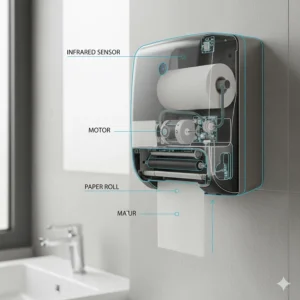
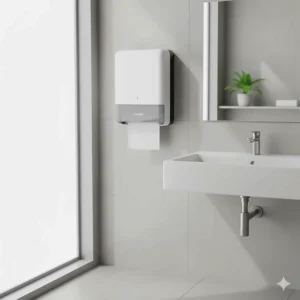
The magic behind a towel dispenser touchless system lies in surprisingly sophisticated sensor technology. Most modern units employ passive infrared (PIR) sensors that detect heat signatures from your hand. When you wave within the sensor’s range—typically 2-6 inches—it triggers a small motor that advances the paper towel roll a predetermined distance.
According to infection control research, touchless dispensers eliminate contact with dispenser surfaces, ensuring users only touch the paper towel they’ll use, making the process significantly more sanitary. This seemingly simple innovation has profound implications for reducing cross-contamination, especially in healthcare and food service environments.
How Motion Sensors Work
Think of the sensor as a vigilant guard constantly monitoring for hand movement. The PIR sensor detects infrared radiation (heat) changes in its field of view. When your hand enters the detection zone, the temperature differential triggers the dispenser mechanism. Quality units use dual-sensor technology to reduce false positives from ambient temperature changes or passing objects.
The dispenser’s “brain”—a simple microcontroller—processes the sensor signal and activates a DC motor for a preset duration. Premium models like the San Jamar Oceans Smart System feature adjustable settings, allowing you to fine-tune dispense lengths from 8 to 16 inches based on your facility’s needs.
Power Source Considerations
Battery-powered models dominate the residential market for their flexibility and wire-free installation. Commercial units like the enMotion dispenser can operate for 4 years on average with one set of batteries, dispensing over 200 rolls through efficient power management. However, batteries eventually die at the worst possible moments—usually when you have company or during your busiest restaurant shift.
AC-powered units eliminate battery anxiety but tether you to outlet proximity. The Innovia under-cabinet model requires wall power, which some view as a limitation but others appreciate for its “set it and forget it” reliability. Hybrid models offering both options provide the best of both worlds, though at a slight price premium.
Key Benefits of Switching to Touchless Dispensers
Superior Hygiene and Reduced Disease Transmission
Let’s get real about germs for a moment. According to the Centers for Disease Control and Prevention, proper hand washing reduces respiratory illnesses like colds by more than 20 percent, and wet hands transmit 1,000 times more germs than dry hands. That’s where your towel dispenser touchless system becomes a hygiene superhero.
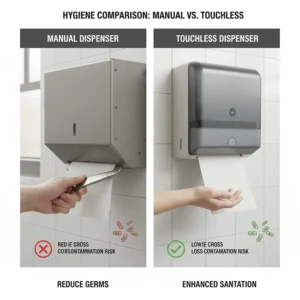
Traditional dispensers create contamination hotspots. Every person touching the lever or crank transfers bacteria to the next user. In high-traffic restrooms, those contact points become bacterial highways. Touchless dispensers eliminate this contact by leveraging motion sensor technology, ensuring users only touch the paper towel they’ll actually use.
The pandemic heightened awareness about surface transmission, but the benefits extend far beyond COVID-19. Norovirus, E. coli, influenza, and countless other pathogens spread through contact with contaminated surfaces. Healthcare facilities have long understood this—which is why they’ve embraced touchless technology decades before it became a residential trend.
Significant Cost Savings Through Controlled Dispensing
Here’s something your accountant will love: touchless dispensers typically reduce paper towel consumption by 20-30% compared to manual systems. How? They dispense precise, controlled amounts rather than letting users grab fistfuls of paper. That half-second delay between dispenses? It’s not a bug—it’s an intentional feature that discourages waste.
Commercial facilities see the most dramatic savings. A typical office building spending $500 monthly on paper towels can slash that to $350-400 simply by installing touchless dispensers. Over a year, that’s $1,800 in savings—enough to pay for the dispensers themselves with money to spare. Multiply that across multiple restroom locations, and the ROI becomes compelling.
Enhanced User Experience and Convenience
There’s something undeniably satisfying about waving your hand and receiving exactly what you need. It’s the small conveniences that make life smoother—especially when your hands are full, wet, or dirty. Automatic paper towel dispensers offer a simple touch-free way of dispensing specific amounts for the job, helping reduce waste while providing convenient automation.
Parents with toddlers particularly appreciate touchless technology. No more little hands cranking the dispenser handle fifteen times, creating a paper waterfall across the bathroom floor. The controlled dispense teaches kids appropriate usage while keeping messes manageable. Similarly, elderly users with limited dexterity find motion-activated dispensers far easier than struggling with levers or cranks.
Environmental Impact and Sustainability
The sustainability conversation around paper towels is complex, but touchless dispensers tip the scales toward eco-friendliness. By reducing consumption through controlled dispensing, they directly decrease the environmental footprint of your paper towel usage. Smart paper dispensers help facilities reduce paper waste and improve operational efficiency by dispensing controlled amounts per use, preventing over-pulling and encouraging responsible usage.
Many commercial touchless dispensers now accommodate high-capacity rolls, which means less packaging waste and fewer refill trips—both reducing your carbon footprint. According to recent research on smart paper dispensers, these systems help facilities demonstrate environmental responsibility by controlling paper usage and supporting sustainable sourcing with certifications like FSC and Green Seal.
Installation Guide: Setting Up Your Touchless Dispenser
Wall-Mounted Installation Steps
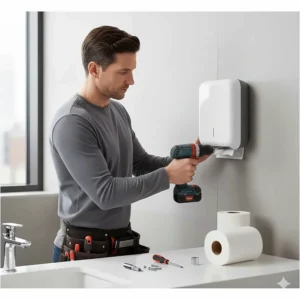
Installing a wall-mounted towel dispenser touchless unit isn’t rocket science, but a methodical approach prevents headaches. Start by choosing your location wisely—typically 48-52 inches from the floor for ADA compliance in commercial settings, or whatever height feels comfortable in your home.
Step 1: Mark Your Position Hold the dispenser against the wall at your desired height. Use a level to ensure it’s straight (eyeballing it always ends badly). Mark the mounting hole locations with a pencil.
Step 2: Check for Studs and Obstacles Use a stud finder to locate wall framing. If possible, mount into studs for maximum stability—these dispensers get used frequently and need solid anchoring. Also scan for electrical wiring or plumbing behind the wall to avoid catastrophic mistakes.
Step 3: Drill Pilot Holes Drill appropriate pilot holes for your wall type. Drywall requires anchors, while studs accept screws directly. Most dispensers include hardware, but verify screw length won’t penetrate too far and damage anything behind the wall.
Step 4: Mount the Bracket Attach the mounting bracket securely using the provided screws. Double-check it’s level before fully tightening—fixing a crooked dispenser later is frustrating. For AC-powered models like the Innovia under-cabinet, ensure the power cord can reach an outlet without creating a trip hazard.
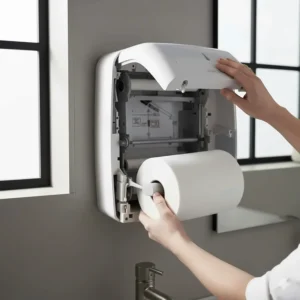
Step 5: Attach the Dispenser Snap or slide the dispenser onto the mounted bracket according to manufacturer instructions. Most use a simple hook-and-lock system. Load batteries if required, insert a paper towel roll, and you’re ready for testing.
Countertop and Under-Cabinet Options
Countertop models like the Innovia Countertop offer installation-free convenience—just unbox, load batteries or plug in, insert a paper towel roll, and you’re operational in under five minutes. The key consideration is placement: choose a spot that’s easily accessible but won’t get knocked over during busy kitchen moments.
Under-cabinet installations provide the cleanest look by utilizing dead space beneath wall cabinets. These require similar mounting steps as wall units but with the added consideration of cabinet material. Most kitchen cabinets use particleboard or plywood, which holds screws adequately. Avoid mounting near the cabinet edge where material is thinner and more prone to splitting.
Maintenance and Troubleshooting Tips
Common Issues and Quick Fixes
Sensor Won’t Detect Hand Movement This frustrating problem usually stems from three culprits: dead batteries, dirty sensor window, or incorrect hand positioning. Replace batteries first—even when they seem fine, low power can cause erratic sensor behavior. Clean the sensor window with a soft, slightly damp cloth (not glass cleaner, which can leave residue). Finally, verify you’re within the detection range, typically 2-6 inches from the sensor.
Paper Towel Jamming Problems Jamming often occurs when paper towels aren’t perfectly aligned with the opening, causing the unit to retract and crinkle the paper, creating obstacles for subsequent dispenses. The fix? Open the dispenser, straighten any crumpled paper, and ensure the roll feeds correctly through the opening. Some brands are more finicky than others about paper alignment—it’s worth spending an extra minute on proper loading.
Inconsistent Dispense Lengths Most touchless dispensers “learn” your preferred sheet length based on the first tear you make after loading a new roll. If you’re getting inconsistent lengths, the solution is recalibration: remove the roll, reload it, leave one sheet hanging out, and make a clean tear at your desired length. The dispenser’s memory resets with each new roll loading.
Excessive Battery Consumption If you’re replacing batteries monthly, something’s wrong. Check for continuous sensor activation from nearby heat sources, sunlight, or reflective surfaces confusing the sensor. Some units have sensitivity adjustments—consult your manual to dial back overly aggressive detection. Commercial units like the enMotion are engineered for efficiency, but budget models may lack sophisticated power management.
Cleaning and Sanitization Best Practices
Touchless dispensers require periodic cleaning to maintain hygiene and appearance. Use mild soap and water or approved disinfectants—avoid harsh chemicals that can damage plastic housings or interfere with sensors. Pay special attention to the paper exit area where dust and paper fibers accumulate.
For commercial environments, establish a cleaning schedule aligned with restroom maintenance. Wipe down exterior surfaces daily and deep clean weekly. The investment in touchless technology loses value if the dispenser itself becomes grimy and uninviting.
Choosing Between Commercial and Residential Models
Residential Needs and Priorities
Home dispensers prioritize aesthetics, ease of use, and reasonable cost over industrial durability. Models like the Innovia Countertop succeed in residential settings because they’re attractive enough to display proudly, simple enough for anyone to operate, and priced within household budgets at $100-120.
Consider your household size and paper towel consumption. A family of five will appreciate the convenience more than a single person living alone. If you entertain frequently, a touchless dispenser impresses guests while handling high-traffic moments smoothly. For households with young children, the controlled dispensing prevents wasteful paper towel play sessions.
Battery versus AC power matters more at home than in commercial settings. The flexibility to move a battery-powered countertop unit from kitchen to garage to bathroom as needed offers versatility. However, if counter space is limited, an under-cabinet AC model keeps things tidy without battery replacement hassles.
Commercial Requirements and Regulations
Commercial environments demand entirely different considerations. Touchless dispensers in commercial settings significantly reduce germ spread while providing controlled dispensing that prevents excessive paper waste. Durability tops the priority list—you need units that withstand thousands of daily uses without failing.
Healthcare facilities face the strictest requirements, often mandating HACCP certification like the enMotion dispenser provides. Food service establishments must consider NSF approval and local health department regulations. Schools need vandal-resistant designs with secure locks preventing tampering.
Traffic volume directly influences model selection. A coffee shop restroom with 50 daily visitors can manage with a mid-tier unit, but an airport terminal bathroom serving thousands requires commercial-grade reliability. Calculate your daily usage and choose dispensers with appropriate capacity and durability ratings.
ADA compliance matters in public facilities—dispensers must mount at accessible heights with appropriate reach ranges. Check local building codes before installation to avoid costly corrections later.
Cost Analysis: Upfront Investment vs. Long-Term Savings
Initial Purchase and Installation Costs
Entry-level touchless dispensers start around $25-35 for basic models like the BIBABLYKE, making the technology accessible to everyone. Mid-range residential options from Innovia run $95-120, while premium commercial units like the enMotion and San Jamar systems cost $150-225.
Installation adds minimal costs for DIY-friendly units—maybe $10-20 for proper mounting hardware if not included. Professional installation runs $50-100 for basic wall mounting, more for electrical work if converting to AC power. Under-cabinet installations typically fall within the DIY skill range, saving professional labor costs.
Don’t forget ongoing expenses: batteries for cordless models ($15-25 annually for residential use, more for commercial) and compatible paper towel rolls. Some dispensers work with any brand, while others require specific products. The enMotion dispenser, for example, needs Georgia-Pacific’s 10″ rolls, slightly limiting your purchasing flexibility.
Calculating ROI for Businesses
Commercial facilities see ROI within 6-18 months through combined savings from reduced paper consumption and lower labor costs. Here’s a realistic scenario: A mid-sized office building with 100 employees spends approximately $400 monthly on paper towels using traditional dispensers. After installing touchless units, consumption drops 25%, saving $100 monthly or $1,200 annually.
The initial investment for 10 commercial dispensers ($1,500-2,000) pays for itself in 15-20 months from paper savings alone. Factor in reduced maintenance labor—fewer refills needed thanks to better efficiency—and ROI accelerates. Add the intangible benefits of improved employee satisfaction and reduced sick days from better hygiene, and the business case becomes compelling.
Healthcare and food service environments see even faster returns due to regulatory compliance benefits and reduced contamination risks. The cost of a single foodborne illness outbreak or healthcare-associated infection far exceeds the investment in proper touchless dispensing systems.
Frequently Asked Questions
❓ How long do batteries last in a towel dispenser touchless unit?
❓ Can touchless paper towel dispensers work with any paper towel brand?
❓ Are touchless dispensers really more hygienic than regular paper towel holders?
❓ Do touchless paper towel dispensers jam frequently?
❓ What's the best mounting height for a touchless paper towel dispenser?
Conclusion: Making Your Final Decision
Choosing the right towel dispenser touchless system comes down to matching features with your specific needs. For homes prioritizing convenience and aesthetics, the Innovia Countertop or Under-Cabinet models deliver reliable performance with stylish designs that complement modern kitchens. Their $100-120 price point sits in the sweet spot between budget and premium categories.
Commercial buyers should focus on durability and capacity first, aesthetics second. The enMotion 10″ dispenser’s 99.99% jam-free operation and 4-year battery life make it worth the $175-225 investment for restaurants, hospitals, and high-traffic facilities. The HACCP certification provides additional peace of mind for food service operations.
Budget-conscious households can dip their toes into touchless technology with the BIBABLYKE model at just $25-35, though expect some compromises in build quality and consistency. It’s perfect for experimenting with the technology before committing to pricier options.
The hygiene benefits of touchless dispensing are undeniable research shows 53% of Americans report that no-touch mechanical paper towel dispensers improve their perception of a facility’s cleanliness. Whether you’re protecting your family from germs or demonstrating your business’s commitment to sanitation, touchless technology delivers tangible value that extends far beyond mere convenience.
Don’t overthink the decision. Start with a single unit in your busiest location-kitchen, bathroom, or primary commercial restroom—and experience the difference firsthand. The wave-activated convenience quickly becomes indispensable, and you’ll wonder how you ever managed with manual dispensers.
Recommended for You
- 7 Best Multifold Paper Towel Dispensers That Save Money (2025)
- 7 Best Electric Paper Towel Dispenser Reviews 2025 (Budget to Premium)
- Best Paper Towel Dispenser Wall: 7 Must-Have Picks 2025
Disclaimer: This article contains affiliate links. If you purchase products through these links, we may earn a small commission at no additional cost to you.
✨ Found this helpful? Share it with your friends! 💬🤗
